You are currently browsing the tag archive for the ‘no sugar no grains’ tag.

I endured 35 days without coffee.
It seemed like an eternity…The longest 35 days of my life!
I did it to challenge myself. I gave up coffee and chocolate for 30 days while some friends in the Vinnie Tortorich’s No Sugar No Grains Facebook group gave up dairy for 30 days. My challenge lasted longer than 30 days because I (stupidly!) offered to start my challenge over when someone new joined the 30 day “No Dairy Challenge.”
I’ve always been a “one latte a day” coffee drinker. Rarely would I have more than one. I brew my espresso at home, enjoying my double shot with cinnamon, vanilla extract and a blend of non-dairy milks (soy, homemade nut/rice, and a splash of coconut).
I wanted to try going a full 30 days without coffee to see if I really missed it. In the past, I’ve tried going a few days or even a week without it, but I always ended up going back to my daily habit. I believe it does take at least 30 days to rid the body of addictive substances and establish new habits.
No– It’s not that I thought I had a caffeine addiction. No one would consider my consumption excessive. I do nothing to excess! Balance is my middle name. It’s my astrological sign: Libra.
I may be different than some people. I don’t use coffee to wake me up, or give me energy. Actually– I enjoy my coffee the most when I can sit back and relax with it. I really look forward to my coffee each day. It calms me. I’ve called it “my sweet elixir.” (Read this previous post for proof!)
Even still– part of me wanted to find out if I would feel significantly better without the coffee in my system. The people who give up coffee for good always seem to hype it up! They feel soooo great, blah, blah, blah. I always wondered if that would or could ever be “me.”
I also think that sometimes it’s good to not always get what we want, right when we want it. It’s a form of discipline. It builds mental toughness. It rejects instant gratification…and entitlement.
(Nah!! It just sucks– let’s be honest!)
The verdict?
I gave up coffee and chocolate for 35 days. The chocolate part wasn’t so bad. Sure, I wanted a chocolate pick-me-up every so often. But it wasn’t a big deal.
As for the coffee– I really, really missed it!
The first 4 days were a breeze. No headaches. No adverse physical symptoms. I was not physically addicted to the caffeine, apparently.
On day 5 everything changed. From that day, onward, I wanted my latte. I longed for my latte. I don’t believe I wanted the caffeine, but I did want the taste…and the comfort.
First, I substituted with various herbal teas.
Then, I discovered Teeccino. I started off buying Teeccino Vanilla Nut Herbal Coffee Tee Bags. They’re tasty, but in a full cup of hot water, they’re still very much like tea. Too watery.
Next, I bought an 11 oz bag of Teeccino Maya French Roast Herbal Coffee. I started brewing the Teeccino grounds in my espresso machine just like I’d brew espresso. This was much better…more concentrated, more like coffee. I made Teeccino lattes. Not quite the same, but not bad at all. Decent!
After the 21st day without coffee, I seriously had a dream about coffee. Is that nuts, or what?
In my dream, I chugged a cup of black coffee. (Funny, because I never drink black coffee!) I was immediately pissed off at myself when I realized that I wasn’t supposed to drink it. I’d ruined the whole challenge! At that point in the dream, I was also getting ready to accept a latte that someone bought for me. It occurred to me (in the dream) that I might get really buzzed from the caffeine of 2 coffee drinks, since I wasn’t used to drinking any.
I woke up glad it was only a dream!
After the first 20 days, I stopped counting every single day. That made it easier because the days didn’t seem to pass as slowly as when I was counting each one. I settled in.
Instead, I figured out the day I could have coffee again, and focused on it:
September 16, 2013
Tomorrow is that day. I made it! I survived without coffee. Physically, I feel the same. For me, there was nothing magical about giving up coffee.
Was it worth the deprivation? NO!
I found out that my daily coffee really does keep me in my happy place. It makes my good life even better. It makes life’s frustrations a little more tolerable. Coffee is soothing. I just need it to feel…content. Balanced.
I’m so glad I did this challenge because now I know without a doubt that I don’t EVER have to do it again. I found out exactly what I wanted to find out. Awesome! That’s the payoff!
Coffee–> I do declare:
You and I will never be separated again!

Cooked Herbed Quinoa
Here is a simple, “back-to-basics” recipe. Herbed quinoa is one of my staple items that I always have in my extra freezer.
I eat this about once a week. I like eating it cold in a salad, soaked in a tangy dressing of fresh squeezed lemon juice and Villa Cappelli olive oil. So refreshing!
Note: I cook up a double batch every time I cook quinoa. I use 1 medium saucepan for each batch, but you could probably just double the recipe using a large saucepan.
STEP ONE
Rinse your measured quinoa in a fine mesh strainer. Use 1 cup for a single batch and 2 cups for a double batch.
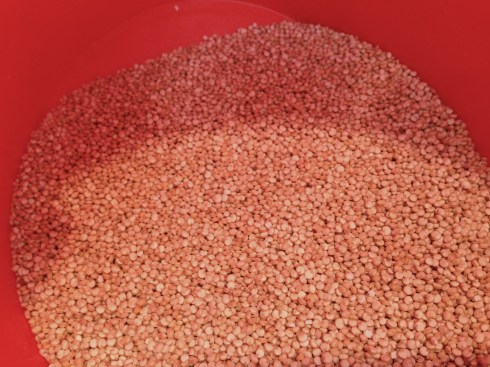
Quinoa is technically a seed, but it cooks up like a grain. It’s called a “pseudo-grain.”

Two sizes of fine mesh strainers
STEP TWO
For every cup of quinoa seed, add 2 cups of water to your saucepan(s). Set the stove to medium heat while you get out your herbs…
STEP THREE
Unload your spice rack! Sprinkle anything and everything into the water:
Veggie broth powder (I like Vegebase)
Dried onion flakes
Garlic powder
Celery salt/sea salt
Black pepper/lemon pepper
Thyme
Sage
Basil
Parsley
Chives
Smoked paprika
Turmeric (makes it a pretty yellow)
Nutritional yeast
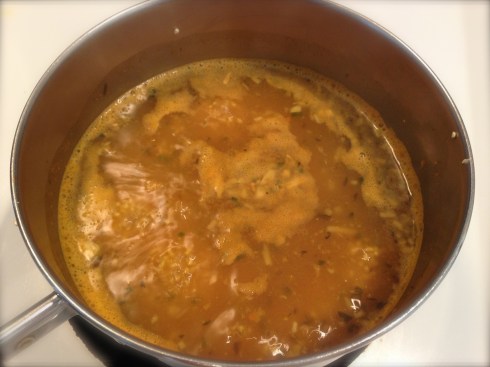
Herbed quinoa simmering
STEP FOUR
Simmer (covered) on medium-low heat for 20 minutes. Turn off the heat and let sit for a few minutes to evaporate any excess moisture.

Double batch of Herbed Quinoa
STEP FIVE
Portion in 1/2 cup glass freezer jam jars. Makes about 6 1/2 servings for a single batch and 13 servings for a double batch. Freeze.

Herbed Quinoa portioned in 1/2 cup jars.
(NSNG = No Sugar No Grains)
——————————————-
Interesting facts about QUINOA:
(all were taken directly from Wikipedia)
- As a chenopod, quinoa is closely related to species such as beetroots, spinach, and tumbleweeds.
- The name is derived from the Spanish spelling of the Quechua name kinwa or occasionally “Qin-wah.”
- It originated in the Andean region of Ecuador, Bolivia, Colombia, and Peru.
- It was domesticated 3,000 to 4,000 years ago, though archeological evidence shows a non-domesticated association with pastoral herding 5,200 to 7,000 years ago.
- The Incas, who held the crop to be sacred, referred to quinoa as chisaya mama or “mother of all grains”, and it was the Inca emperor who would traditionally sow the first seeds of the season using “golden implements”.
- Protein content is very high for a pseudo-cereal (14% by mass), yet not as high as most beans and legumes. Quinoa’s protein content per 100 calories is higher than brown rice, potatoes, barley and millet, but is less than wild rice and oats.
- Nutritional evaluations of quinoa indicate that it is a source of complete protein. Furthermore, it is a good source of dietary fiber and phosphorus and is high in magnesium and iron. Quinoa is also a source of calcium.
- Quinoa is gluten-free and considered easy to digest. Because of all these characteristics, quinoa is being considered a possible crop in NASA’s Controlled Ecological Life Support System for long-duration human occupied spaceflights.
- Quinoa may be germinated in its raw form to boost its nutritional value. Germination activates its natural enzymes and multiplies its vitamin content. In fact, quinoa has a notably short germination period: Only 2–4 hours resting in a glass of clean water is enough to make it sprout. This process, besides its nutritional enhancements, softens the seeds, making them suitable to be added to salads and other cold foods.
- Quinoa leaves are also eaten as a leaf vegetable, but the commercial availability of quinoa greens is limited. High levels of oxalic acid in the leaves and stems are found in all species of the Chenopodium genus.
- Due to quinoa’s natural coating of bitter-tasting saponins, the plant is unpopular with birds and therefore requires minimal protection during cultivation. After harvest, the seeds are typically processed to remove this coating.
- The toxicity category rating of quinoa saponins treats them as mild eye and respiratory irritants and as a low gastrointestinal irritant. The saponin is a toxic glycoside, a main contributor to its hemolytic effects when combined directly with blood cells. The risks associated with quinoa are minimal, provided it is properly prepared and leaves are not eaten to excess.
- In South America, quinoa saponin has many uses outside of consumption, which includes detergent for clothing and washing, and as an antiseptic for skin injuries.
- Quinoa is grown from coastal regions (Chile) to over 4,000 m (13,120 ft) in the Andes near the equator. Most of the cultivars are grown between 2,500 m and 4,000 m.
- Depending on the variety, quinoa’s optimal growing conditions are in cool climates with temperatures that range from 25°F/−3°C during the night, to near 95°F/35°C during the day. Rainfall conditions are highly variable between the different cultivars, ranging from 300 to 1,000 mm during growing season.
- Quinoa does best in sandy, well-drained soils with a low nutrient content, moderate salinity, and a soil pH of 6 to 8.5.
- Quinoa is usually harvested by hand and rarely by machine, because the extremely variable maturity periods of native quinoas complicates mechanization. Harvest needs to be precisely timed to avoid high seed losses from shattering, and different panicles on the same plant mature at different times. Handling involves threshing the seedheads and winnowing the seed to remove the husk. Before storage, the seeds need to be dried in order to avoid germination.
- Quinoa has become increasingly popular in the United States, Europe, China and Japan where the crop is not typically grown, increasing crop value. Between 2006 and early 2013 quinoa crop prices have tripled.
- The popularity of quinoa in non-indigenous regions has raised concerns over food security. Due to continued widespread poverty in regions where quinoa is produced, and because few other crops are compatible with the soil and climate in these regions, it is suggested that the inflated price of quinoa disrupts local access to food supplies. However, anthropologist Pablo Laguna has noted that farmers tend to save quinoa for personal consumption, and consumption of the grain in nearby cities has been traditionally lower. According to Laguna, the net benefit of increased revenue for farmers outweighs the costs, saying that it is “very good news for small, indigenous farmers”.
- The United Nations General Assembly declared 2013 as the “International Year of Quinoa” in recognition of ancestral practices of the Andean people, who have preserved quinoa as food for present and future generations, through knowledge and practices of living in harmony with nature. The objective is to draw the world’s attention on the role that quinoa plays in providing food security, nutrition and poverty eradication, in support of achieving Millennium Development Goals.



 Freeheel Vegan