
You are currently browsing the tag archive for the ‘beef’ tag.
Things That Make Me Go “Huh?”
EXHIBIT B: DAIRY LABELS

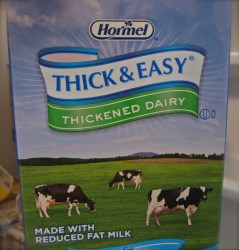
Do you ever really notice the pictures on the milk jugs? I’m talking about those cute drawings of dairy cows on perfect green pastures, with– of course– the stereotypical red barn.
Take a quick glance at any dairy container and you’ll find idyllic pastoral pictures. I opened the fridge at work and found 3 different brands, complete with delightful farm depictions: Darigold, Hormel Health Labs, and Lucerne.
What the dairy industry would have you believe is that cow’s milk products actually come from cows living wonderful lives. But does the average dairy cow eat grass? No.
What do dairy cows eat? Let’s consult the Dairy Production page of the U.S. Environmental Protection Agency (EPA) to find out what’s in their Total Mixed Ration (TMR):
- Corn silage
- Alfalfa/grass silage
- Alfalfa hay
- Corn
- Soybean meal
- Fuzzy whole cottonseed
- Commodity feeds (corn gluten, distillers grains, soybean hulls, citrus pulp, candy bars, etc.)
No, the cows aren’t eating grass.
Do you notice something else? The Lucerne label says “Calcium Fortified.” Why would that be? Aren’t dairy products supposed to be naturally high in calcium? Why must they fortify?
Think about it for a minute… 
Calcium is a chemical element (Ca) and an alkaline Earth metal. The calcium ion (Ca2+) is essential for human physiology, notably for nerve conduction, neurotransmitter release, and muscle contraction. Calcium is stored in the bones and teeth.
Minerals such as calcium come from the ground. Dark, leafy plants are rich in calcium.
While there is abundant calcium in milk from cows eating grass, dairy cows don’t typically eat grass. Are dairy products calcium-fortified because the cows themselves aren’t getting enough calcium?
Would the dairy industry– i.e. The National Dairy Council– make claims that “TMR-fed” cow’s milk is an “excellent” source of calcium if they didn’t fortify the milk?
Remember…
If you have more than a few cows, it’s not practical to “let” them all eat grass, over acres of pasture land. Why? Because milking occurs twice a day, without interruption. It would be costly and labor intensive to let the cows out, bring them in for milking, let them out, bring them in…
Dairying is a business, and profitability in any business depends on it running efficiently, with minimal costs. (The cows you see on pasture are likely steers being raised for beef, not dairy cows.)
Here are some realistic images of dairy farms:
I took pictures of this dairy in Idaho over 28 sec while traveling (as passenger) at 75 mph:

Idaho Dairy #1 – 2/11/12 – 11:17:20 AM
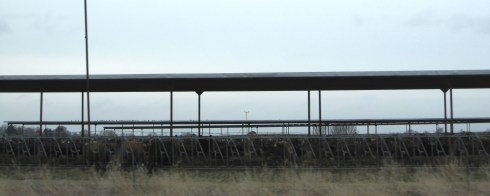
Idaho Dairy #1 – 2/11/12 – 11:17:25 AM

Idaho Dairy #1 – 2/11/12 – 11:17:28 AM
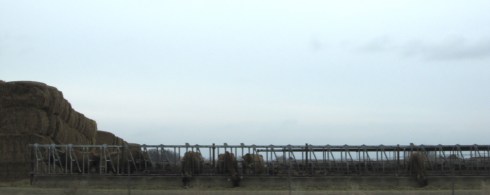
Idaho Dairy #1 – 2/11/12 – 11:17:32 AM
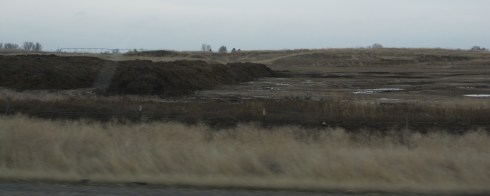
Idaho Dairy #1 – 2/11/12 – 11:17:41 AM
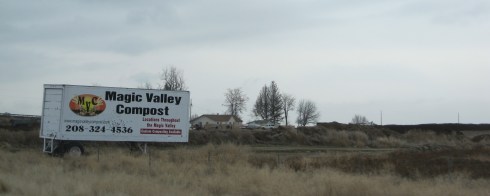
Idaho Dairy #1 – 2/11/12 – 11:17:48 AM
Only 5 minutes later I saw another dairy:
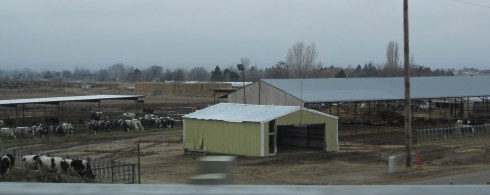
Idaho Dairy #2 – 2/11/12 – 11:22:43 AM
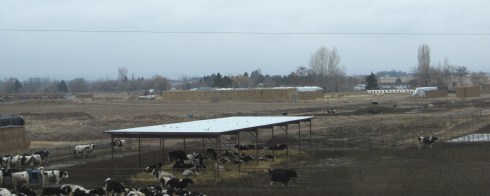
Idaho Dairy #2 – 2/11/12 – 11:22:46 AM
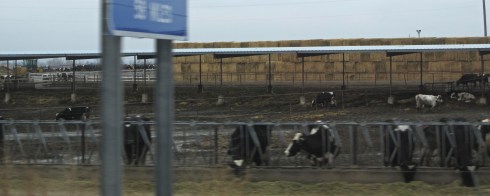
Idaho Dairy #2 – 2/11/12 – 11:22:56 AM
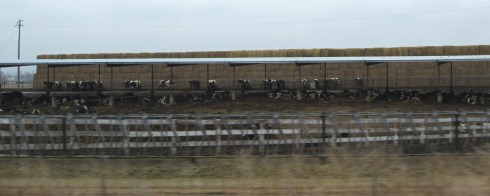
Idaho Dairy #2 – 2/11/12 – 11:22:59 AM
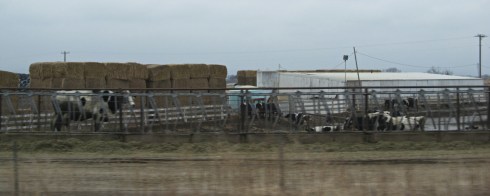
Idaho Dairy #2 – 2/11/12 – 11:23:02
Finally, dairy cows in the American Southwest:

Dairy #3 – 3/12/12
Final Thoughts…
- Let the cows eat grass.
- Let the cows nurture their babies with their own milk.
- Humans have no dietary requirement for dairy products.
- Get your calcium from plant sources.
- GO VEGAN.
“But there are farms in this country, and more of them all the time, where animals lead very happy lives, and have one bad day.” -Michael Pollan
Michael Pollan made that statement on the February 1, 2011 Oprah episode, “Oprah and 378 Staffers Go Vegan: The One-Week Challenge.”
Since the show aired, I haven’t stopped thinking about that phrase: One bad day.
Getting slaughtered for no good reason certainly qualifies as a bad day.
But, does Michael Pollan really believe the fantasy that animals raised and “harvested” on small farms only have one bad day?
When a heifer or cow gives birth and her baby is taken away…does that count as a bad day? When she gets her supernumerary teats removed or her udders “flamed” (to remove udder hair) does that count as a bad day? When a cow gets painful mastitis or laminitis, does that add more days to the “bad” column?
For “beef” cattle…Is the day of castration a bad day? Disbudding? Branding? For pigs…Is the day of tooth/tusk trimming, ear tagging, tail docking, and castration a bad day? Just because it’s “routine husbandry practice” doesn’t mean that it’s not painful.
Now– and this might be difficult, but let’s try– let’s estimate the number of “bad days” for egg laying hens, for chickens raised for meat (i.e “broilers”) and for turkeys, all within the “Certified Humane Raised & Handled” label. You can download the actual Standards documents here.
 “Certified Humane” Eggs…
- “The Animal Care Standards for Laying Hens do not require that hens have access to range.” (2009 Standards Manual: Egg Laying Hens)
- Minimum stocking density requirements: 1 square foot to 1 1/2 square feet per hen. (E 16: Stocking Density).
- Cannibalism is a common problem for “cage-free” housing (i.e. “one big cage” instead of separate battery cages).
- Beak trimming/tipping is permitted preventatively in “flocks that are susceptible to outbreaks of cannibalism.” (H 6: Physical alterations)
- Other problems: significant feather loss and fowl mite infestation.
“Certified Humane” Chickens…
- “The Animal Care Standards for Chickens Used in Broiler Production do not require that chickens have access to range.” (2009 Standards Manual: Chickens)
- Maximum stocking density = 6 lbs per square foot.
- “Broilers” are susceptible to leg deformities, lameness (difficulty walking), and hock burn/breast blisters.
How many bad days are we up to? Or– for birds– does all this simply add up to one bad life? Humane?
Look…let’s stop pretending that animal agriculture– of the variety that Michael Pollan likes to promote (i.e. “happy meat”)– is a “one bad day” scenario. One can only make such a statement out of ignorance.
BUT…Even if animals only endured one bad day, I still believe that’s one bad day too many. Why kill if it’s unnecessary? We don’t need to eat eggs, chickens and turkeys. We don’t need to eat pigs and cows. We don’t need to consume milk from cows and cheese from goats or sheep.
How would you like it if someone decided to kill you? Is that okay? After all, you “led a good life, and it’s just one bad day.” I don’t see how it can be justifiable to treat animals differently than we would like ourselves treated. Animals value their lives just like we do. No one wants to have bad days, and certainly not bad days that can be prevented.
[You can hear Michael Pollan’s statement with your own ears by listening to Episode 46 of the Coexisting With Nonhuman Animals podcast. J.W. provides excellent commentary on that Oprah show episode. Michael Pollan’s statement is 1 hour, 2 minutes, 30 seconds into the podcast.]



 Freeheel Vegan