
You are currently browsing the category archive for the ‘Unhappy About Happy Meat’ category.

Maybe I’ve been living under a slab of tofu (as the vegan saying goes), but I only just watched Chipotle’s “Back to the Start” commercial 3 days ago. If you haven’t seen it, watch the 2 minute, 20 second commercial here.
The reason “Back to the Start” was in the news is that it won top honors at the 21st Annual AICP Show (The Art & Technique of the American Commercial). Here is an excerpt from this article, which briefly describes the short film:
[Promoting the Chipotle Cultivate Foundation, “Back To The Start” was directed by Johnny Kelly of Nexus Productions, London, for Creative Artists Agency, Los Angeles. “Back To The Start” centers on a misguided farmer who slowly turns his family farm into an industrial animal factory before seeing the error of his ways and opting for a more sustainable future. The beautifully executed stop motion animation is all contained in one long panning “shot.”]
The music is critical in setting the emotional tone of this short film. Country music legend Willie Nelson performs Coldplay’s 2003 (US) EP, “The Scientist.” The piano ballad is slow, hypnotic, and sorrowful. No surprise- the song lyrics are about the sadness and regret of love’s dissolution. It’s depressing.
Yet, when the music is played as background to the video animation, the song’s melancholy quality eventually gives way to a soothing and hopeful feel. (At least that seems to be the intent.)
As mentioned above, the animation tells the story of a farmer’s progression from modest and pasture-based animal farming, to institutional and intensive, and then back to small again.
Over the chirping of birds in the opening frame, we’re introduced to the farmer– with wife and baby– and his one pig.
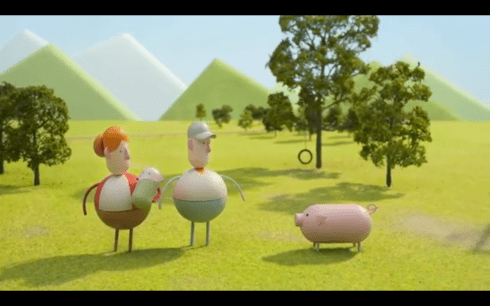
The one pig turns into several, and the barns go up. There are cows, too. Everything expands. The animals go inside.
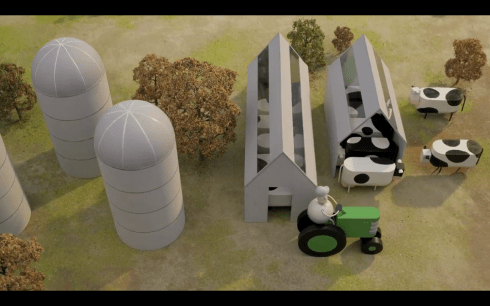
Then, we leave the farm and the green trees to enter the factory. We see the dark contrast of uniform pink pigs against sterile grey metal. We see mechanized meat production and semi trucks.

It all turns chilly and dark when we see the forlorn, sleepless farmer reflecting on what his farm has become. He reaches a point that communicates, “Enough is enough,” and he starts opening up the animal enclosures. Barren Earth returns to green grass and trees.

In the final scene, the farmer loads a wooden crate into a Chipotle Mexican Grill truck with chickens pecking nearby. He joins hands with his wife and stands with his now-adult child and one pig.

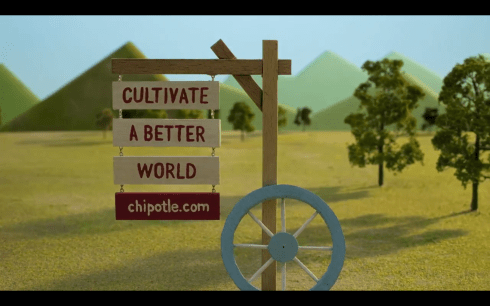
The music fades out with a sign: “Cultivate a Better World”
The lyrics used in the animation, from “The Scientist,” are:
I was just guessing at numbers and figures
Pulling the puzzles apart
Questions of science, science and progress
Don’t speak as loud as my heart
Nobody said it was easy
It’s such a shame for us to part
Nobody said it was easy
No one ever said it would be so hard
I’m going back to the start.
———————————————————————————————————————
I think some would feel comforted by the ending. I am unsettled by it.
I’ll state the obvious first. This is an animation about rejecting factory farms/CAFOs and intensive animal agriculture practices. It’s about improving welfare for “farm” animals. The expressed mission of the Chipotle Cultivate Foundation is:
“…creating a more sustainable and healthful food supply and to raising awareness concerning food issues. This is realized through the support of family farmers and their communities, educators and programs that teach younger generations about food matters, along with support for ranchers and farmers who are working to develop more sustainable practices.”
Few people– outside of industry itself– will deny that factory farm practices treat animals terribly. For those who consider industrial-scale animal agriculture unacceptable at best, and abhorrent at worst, this animation clearly points to “a way out.”
There are 3 stakeholders in the animal agriculture scenario: farmer, consumer, and animal. Farmers and consumers share the responsibility for taking action to “Cultivate a Better World.” The actions that farmers and consumers take determines the outcome for animals.
When the farmer decides to release his animals from their confinement, the implication remains that the animals will still die. We must assume that the crate he loads onto the truck contains the flesh of his pastured animals.
The farmer’s “way out” is going “back to the start,” or back to the way farming “used to be.” The farmer has his own set of interests. I don’t question that one of the farmer’s interests would be improved welfare for animals. Better treatment is better treatment.
For meat consumers, I think that the short film succeeds in generating feelings of relief and hopefulness. Too much relief?
I still remember my own feelings of distress when I learned about modern meat production. I was horrified. I felt naive: How could I not know what was going on? I was angry at the people who would let this kind of brutality continue. And I felt guilty when realizing that, if I bought animal products, it meant I would continue to support cruel practices.
Like the farmer who says, “Enough is enough,” people who feel horrified, naive, angry and guilty desperately want and need their own “way out.” Who can blame them? What decent person wouldn’t seek such deliverance?
People may opt for so-called humane, grass-fed, free-range, pasture-based, sustainable, and organic animal products, but I think we need to discuss where that really takes us as a species. Is going back in time– i.e. “back to the start”– really going in the right direction?
For animals, certainly better treatment is better treatment. But from the animal’s perspective, is it acceptable? Should the farmer’s pastured pig feel a sense of relief when he is stunned, stuck, and bled out?
There was a time when I felt good about purchasing “happy meats.” I didn’t feel bad, I didn’t feel neutral, I actually felt good. The phrase “happy meat” usually refers to the animal being happy before he or she is killed, but I’ve come to the realization that “happy” actually describes the consumer.
I’m no longer happy about “happy meat.” I’m unsettled. And I think we can “Cultivate a Better World” in an even better way. I’ll use the Chairman of Chipotle Cultivate Foundation, Steve Ells’ own words:
“Delicious food can be produced without exploiting the farmers, the animals, or the environment. Chipotle has proven this to be true, but Chipotle is only one small part of the solution. Our goal now should be to have all food produced as sustainably as possible.”
I think his words, “Delicious food can be produced without exploiting the farmers, the animals or the environment” is spot on. After that, he lost me. Chipotle is not promoting Veganism. I must ask: Isn’t killing a form of exploitation?
———————————————————————————————————————
I’m going to re-interpret the commercial’s ending, starting with the chilly blue frame:
When I see the farmer hit rock bottom, I see his “lightbulb” moment. I see the farmer change his whole view about animals. He realizes that “his” pigs don’t really “belong” to him at all. He recognizes that each animal is an individual who deserves autonomy. He empathizes like never before.
The farmer admits that it’s unnecessary to eat animals. He becomes motivated to farm plants, not animals.
Then, I see the farmer really liberating the animals. I see animals on the green pasture of sanctuaries. I see animals being cared for without being exploited.
Finally, I see the farmer loading a crate of onions, peppers, corn and beans into the back of the Chipotle Mexican Grill truck. I see him join hands with his wife with the satisfaction of knowing that he really IS cultivating a better world.
The pig is safe.

“But there are farms in this country, and more of them all the time, where animals lead very happy lives, and have one bad day.” -Michael Pollan
Michael Pollan made that statement on the February 1, 2011 Oprah episode, “Oprah and 378 Staffers Go Vegan: The One-Week Challenge.”
Since the show aired, I haven’t stopped thinking about that phrase: One bad day.
Getting slaughtered for no good reason certainly qualifies as a bad day.
But, does Michael Pollan really believe the fantasy that animals raised and “harvested” on small farms only have one bad day?
When a heifer or cow gives birth and her baby is taken away…does that count as a bad day? When she gets her supernumerary teats removed or her udders “flamed” (to remove udder hair) does that count as a bad day? When a cow gets painful mastitis or laminitis, does that add more days to the “bad” column?
For “beef” cattle…Is the day of castration a bad day? Disbudding? Branding? For pigs…Is the day of tooth/tusk trimming, ear tagging, tail docking, and castration a bad day? Just because it’s “routine husbandry practice” doesn’t mean that it’s not painful.
Now– and this might be difficult, but let’s try– let’s estimate the number of “bad days” for egg laying hens, for chickens raised for meat (i.e “broilers”) and for turkeys, all within the “Certified Humane Raised & Handled” label. You can download the actual Standards documents here.
 “Certified Humane” Eggs…
- “The Animal Care Standards for Laying Hens do not require that hens have access to range.” (2009 Standards Manual: Egg Laying Hens)
- Minimum stocking density requirements: 1 square foot to 1 1/2 square feet per hen. (E 16: Stocking Density).
- Cannibalism is a common problem for “cage-free” housing (i.e. “one big cage” instead of separate battery cages).
- Beak trimming/tipping is permitted preventatively in “flocks that are susceptible to outbreaks of cannibalism.” (H 6: Physical alterations)
- Other problems: significant feather loss and fowl mite infestation.
“Certified Humane” Chickens…
- “The Animal Care Standards for Chickens Used in Broiler Production do not require that chickens have access to range.” (2009 Standards Manual: Chickens)
- Maximum stocking density = 6 lbs per square foot.
- “Broilers” are susceptible to leg deformities, lameness (difficulty walking), and hock burn/breast blisters.
How many bad days are we up to? Or– for birds– does all this simply add up to one bad life? Humane?
Look…let’s stop pretending that animal agriculture– of the variety that Michael Pollan likes to promote (i.e. “happy meat”)– is a “one bad day” scenario. One can only make such a statement out of ignorance.
BUT…Even if animals only endured one bad day, I still believe that’s one bad day too many. Why kill if it’s unnecessary? We don’t need to eat eggs, chickens and turkeys. We don’t need to eat pigs and cows. We don’t need to consume milk from cows and cheese from goats or sheep.
How would you like it if someone decided to kill you? Is that okay? After all, you “led a good life, and it’s just one bad day.” I don’t see how it can be justifiable to treat animals differently than we would like ourselves treated. Animals value their lives just like we do. No one wants to have bad days, and certainly not bad days that can be prevented.
[You can hear Michael Pollan’s statement with your own ears by listening to Episode 46 of the Coexisting With Nonhuman Animals podcast. J.W. provides excellent commentary on that Oprah show episode. Michael Pollan’s statement is 1 hour, 2 minutes, 30 seconds into the podcast.]



 Freeheel Vegan