You are currently browsing the tag archive for the ‘grass’ tag.
Things That Make Me Go “Huh?”
EXHIBIT B: DAIRY LABELS

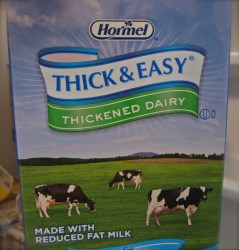
Do you ever really notice the pictures on the milk jugs? I’m talking about those cute drawings of dairy cows on perfect green pastures, with– of course– the stereotypical red barn.
Take a quick glance at any dairy container and you’ll find idyllic pastoral pictures. I opened the fridge at work and found 3 different brands, complete with delightful farm depictions: Darigold, Hormel Health Labs, and Lucerne.
What the dairy industry would have you believe is that cow’s milk products actually come from cows living wonderful lives. But does the average dairy cow eat grass? No.
What do dairy cows eat? Let’s consult the Dairy Production page of the U.S. Environmental Protection Agency (EPA) to find out what’s in their Total Mixed Ration (TMR):
- Corn silage
- Alfalfa/grass silage
- Alfalfa hay
- Corn
- Soybean meal
- Fuzzy whole cottonseed
- Commodity feeds (corn gluten, distillers grains, soybean hulls, citrus pulp, candy bars, etc.)
No, the cows aren’t eating grass.
Do you notice something else? The Lucerne label says “Calcium Fortified.” Why would that be? Aren’t dairy products supposed to be naturally high in calcium? Why must they fortify?
Think about it for a minute… 
Calcium is a chemical element (Ca) and an alkaline Earth metal. The calcium ion (Ca2+) is essential for human physiology, notably for nerve conduction, neurotransmitter release, and muscle contraction. Calcium is stored in the bones and teeth.
Minerals such as calcium come from the ground. Dark, leafy plants are rich in calcium.
While there is abundant calcium in milk from cows eating grass, dairy cows don’t typically eat grass. Are dairy products calcium-fortified because the cows themselves aren’t getting enough calcium?
Would the dairy industry– i.e. The National Dairy Council– make claims that “TMR-fed” cow’s milk is an “excellent” source of calcium if they didn’t fortify the milk?
Remember…
If you have more than a few cows, it’s not practical to “let” them all eat grass, over acres of pasture land. Why? Because milking occurs twice a day, without interruption. It would be costly and labor intensive to let the cows out, bring them in for milking, let them out, bring them in…
Dairying is a business, and profitability in any business depends on it running efficiently, with minimal costs. (The cows you see on pasture are likely steers being raised for beef, not dairy cows.)
Here are some realistic images of dairy farms:
I took pictures of this dairy in Idaho over 28 sec while traveling (as passenger) at 75 mph:

Idaho Dairy #1 – 2/11/12 – 11:17:20 AM
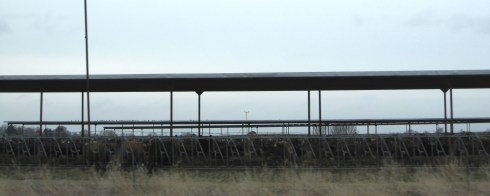
Idaho Dairy #1 – 2/11/12 – 11:17:25 AM

Idaho Dairy #1 – 2/11/12 – 11:17:28 AM
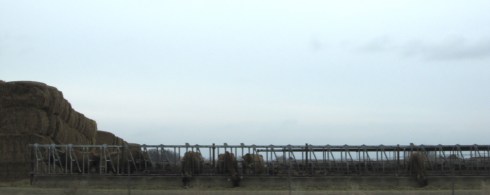
Idaho Dairy #1 – 2/11/12 – 11:17:32 AM
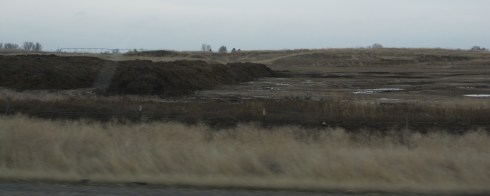
Idaho Dairy #1 – 2/11/12 – 11:17:41 AM
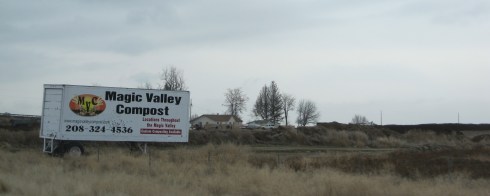
Idaho Dairy #1 – 2/11/12 – 11:17:48 AM
Only 5 minutes later I saw another dairy:
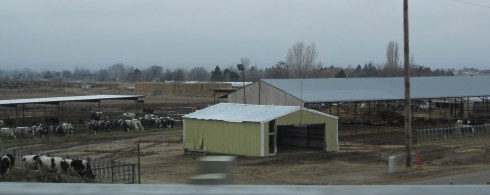
Idaho Dairy #2 – 2/11/12 – 11:22:43 AM
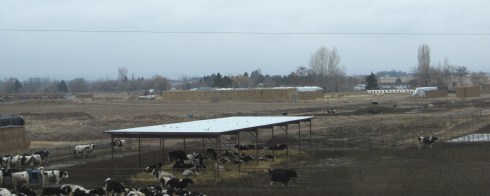
Idaho Dairy #2 – 2/11/12 – 11:22:46 AM
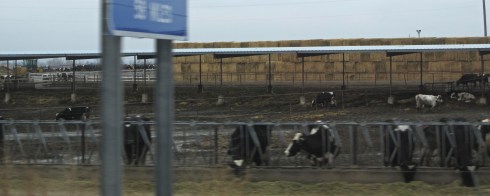
Idaho Dairy #2 – 2/11/12 – 11:22:56 AM
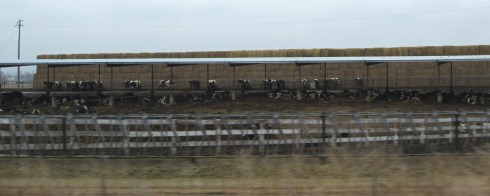
Idaho Dairy #2 – 2/11/12 – 11:22:59 AM
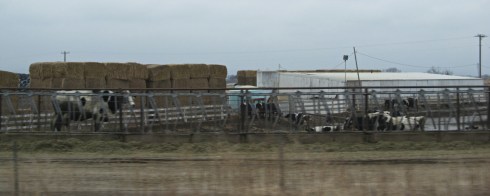
Idaho Dairy #2 – 2/11/12 – 11:23:02
Finally, dairy cows in the American Southwest:

Dairy #3 – 3/12/12
Final Thoughts…
- Let the cows eat grass.
- Let the cows nurture their babies with their own milk.
- Humans have no dietary requirement for dairy products.
- Get your calcium from plant sources.
- GO VEGAN.
 I did a home safety assessment for a patient at work today. I went with her & her husband to their rural home that includes a small herd (i.e. <25) of cows raised for meat. Having never been in this particular situation before, I was keenly interested to learn everything I could about the fate of those animals. I watched the cows innocently & peacefully grazing on grass as my patient was more than happy to answer all my questions.
By anyone’s definition, this is about as “humane” as an animal farm can get. The bulls are not castrated, so the breeding is natural. The cows have a lovely green pasture with a beautiful view of trees & mountains in a location w/ a mild climate. A mobile unit comes to the farm to slaughter the animals on site. The animals are killed when not much more than ~18 months (“so that the meat doesn’t get too tough”…and older animals are only “good” for hamburger.) The animal’s body is hauled off to a butcher shop in a nearby city for about a week of aging (she called it “hanging”) & then processing into the various meat cuts.
This will be the last herd that my patient & her husband will have because they are both elderly & it’s getting to be too much work for them. She also admitted that for health reasons everyone in her family is eating less beef so it is clearly not a necessary food source. She clearly has a certain fondness for her animals & yet her speaking tone was matter of fact and clinical.
I found the whole experience quite unsettling. Since going vegan, I have never needed confirmation, but yet being there confirmed in my mind that I am on the right track. If this little family farm is AS good as it gets, I still don’t want any part of it. I looked at the eyes of those animals. I put myself in their situation. I can only come to the conclusion that those animals don’t deserve to be suddenly killed when it is so unnecessary to kill them. It is unnecessary to eat them. And they really are babies…18 months. Cows can live to be 20 years or more if given the chance.
More Q’s I have: What happens when the mobile slaughter unit drives up? What is the process then? I didn’t have time to find out all the answers to every question that I later thought of. What happens when one cow is harmed..killed? When do the other cows know that they, too, will be harmed? I still want to know more. Nevertheless, I reflect on this interaction without tears, without anger. I am disturbed by it because it is so unfair. So unjust. But I am glad that no more animals on this particular farm will be bred just to be killed. I hope that more people will go vegan.
(Written April 5, 2012)



 Freeheel Vegan