
You are currently browsing the tag archive for the ‘animal rights’ tag.

An Essay on Consistency…
Sooner or later, people who abstain from consuming animal products will listen to friends, acquaintances, or family members declare, “I only buy humane meat,” or “I only buy free-range eggs,” or “I only buy organic milk.” These are the actual words spoken.
“I only buy humane meat, etc” could be one person’s response to some horrific undercover video footage or another’s solution to factory farming. The health-conscious say this in the context of minimizing exposure to rBGH, E-Coli O157:H7 or BSE. Environmentalists might include the word “sustainable.” Followers of Michael Pollan make this statement in support of the family farmer.
When I hear “I only buy humane meat, etc,” I also hear the following unspoken messages: “Hey look, I’m doing something,” “I care about the animals, too,” and “I recognize there is a problem.” I would like to respond to both the spoken words and the unspoken messages.
“I only buy humane meat.” Really? So when you go out to restaurants, what do you order? What kind of pizza do you get? On the road, do you occasionally opt for the convenience of a fast-food restaurant drive-through? In the grocery store, what choices do you make when buying canned soups or frozen entrees? Do you always check labels?
“I only buy free-range eggs.” “I only buy organic milk.” Ok. When you go out for breakfast, what do you have? Do you ever get a pastry at the coffee shop? Do you ask your barista about the milk in your espresso? How about an ice cream cone on a summer day? What about the cheese in your sandwich, taco, or salad? Grocery shelves are lined with baked, packaged, and processed foods containing egg and milk ingredients. Is what you buy free-range and organic? Are you that selective?
These are the types of questions that come to my mind when I hear someone say, “I only buy humane meat, etc.” My first reaction is, “I’m not sure about that.” Chances are, you don’t only buy humane meat, etc. If you truly did, you would be reading labels, asking questions about ingredients, and eating like vegans do nearly all of the time because the vast majority of animal-derived foods do not proclaim to be “humane,” “free-range,” “organic,” ‘”sustainable,” or “grass-fed.”
“But,” you say, “I didn’t mean EVERYTHING I buy is humane/free-range/organic/etc.” Exactly. My point is that consistency is lost. Being true to your own word is meaningless. Whether you say you “only buy humane meat” because of the animal cruelty videos, the factory farms, your health, the environment, the family farmers or some other reason, please take a critical look at whether you are actually doing it. If you say you do something, then do it consistently.
My second reaction when I hear “I only buy humane meat, etc” is, “So, what?” What do labels like “humane,” “free-range,” “organic” (as applied to meat and milk), and “sustainable” really mean? Do you know? Do you want to know? What do you think they mean? What are you hoping they mean? Why do you care?
The first answer to the question “What do the labels mean?” is “Not much.” The second answer is, “It doesn’t matter.” “Humane” doesn’t matter because unnecessary killing can’t be humane. “Free-range” doesn’t matter because it’s still slavery. “Organic milk” doesn’t matter because cow’s milk belongs to baby cows, not humans. “Grass-fed” doesn’t matter because grass is what the cows would be eating if we would just leave them alone in the first place.
None of these labels matter to me. Animals should not be the property of humans. Animals are not things, they are sentient beings. Animals belong to themselves. They deserve the basic right to live their own lives. The problem is not “how” we use animals, the problem is “that” we use animals.
When you say “I only eat humane meat, etc,” is that really what you do? Is that really what you want to do? Or, are you actually just saying, “Hey look, I’m doing something,” or “I care about the animals, too,” or “I recognize there is a problem.”? If you indeed want to do something, then act. If you do care about the animals, then really care. Go vegan. If you do recognize there is a problem, then don’t deny it. Learn more about it, take action, and be consistent.
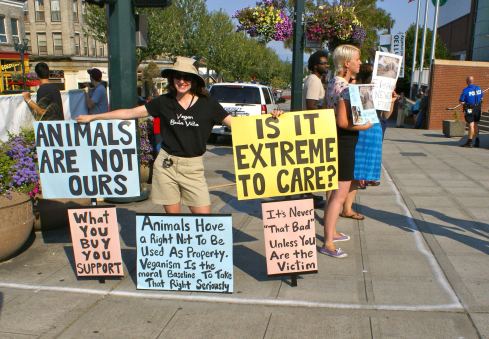
In closing, being consistent does not make you “radical” or “extreme,” although people who abstain from consuming all animal products are often called these things. Acting consistently on principle simply shows integrity. Being consistent demonstrates conviction and the willingness to stand up for something that is important, no matter what. Consistency in action is necessary for positive change. Be consistent, yes. But please leave the animals alone.
I only buy humane meat. It is 100% plant-derived. It is humane meat.
(Picture taken while mountain biking in Roslyn, WA, Sept 24, 2011)
The problem is animal exploitation. The solution is Veganism.
Step 1: You. Change must start with YOU. First you go vegan. You stop consuming animals, wearing animals, and buying products made of animals or tested on animals. You stop going to venues using animals to entertain. You stop accepting that animals are just commodities to use. You start thinking about animals as individuals with their own interests. Simple.
Step 2: NOW WHAT?? Now that you’ve changed, what do you do next? Do you leave it at that? Or, do you speak up and try to help effect change in others? Remember – the point of going vegan isn’t to join a “club” that follows a strict set of “rules.” The point is to help solve a very serious social justice problem.
Solving problems of gargantuan proportion depends on the collective effort of many. No “group” is more oppressed than non-human animals. For the human culture to stop conceptualizing animals as primarily “things to consume” is going to take a monumental push for change.
Definitions: “push”
- To urge forward or urge insistently; pressure: “Push a child to study harder.”
- To extend or enlarge: “Push society past the frontier.”
- To promote or sell: “The author pushed her latest book.”
So who is pushing for change? Vegans. Non-vegans won’t do it. Vegetarians won’t do it. Vegans are the only ones advocating 100% for the rights of animals not to be used.
Passionate vegans work for the greater good. By promoting Veganism, we “urge” others to act with fairness toward sentient beings. We put “pressure” on the status quo. We ask others to “enlarge” their circle of compassion to include all animals. We “promote” non-violence. These are good things. Yet, passionate, active, vocal vegans are frequently called “pushy.”
Definition: “pushy”
- offensively assertive or forceful
- marked by aggressive ambition and energy and initiative
Hmm…pushy sounds bad. So how did we get from “push” to “pushy?” How did we get from the words, “urge forward / extend / promote” to “offensive” and “aggressive?”
I think it has more to do with how non-vegans react to being challenged than anything else. I don’t think it really matters what the frequency– the content– the delivery method– of the vegan message is. The vegan message itself is considered inherently “aggressive” in a culture where animal exploitation is ubiquitous. Where animal slaughter is condoned, those who speak in protest are considered the “offensive” ones. All a vegan has to do is open his or her mouth to be labelled “pushy.” No one minds a quiet vegan!
Push…pushy. It doesn’t really matter. The bottom line is we have a long way to go to shift the paradigm. The animals need our help so we can’t keep quiet. So, spreaders of the vegan message: Keep pushing for change…you pushy, pushy vegans!
(Picture taken September 12, 2011 at the Ringling Circus protest in Everett, WA)



 Freeheel Vegan