
You are currently browsing the monthly archive for April 2012.
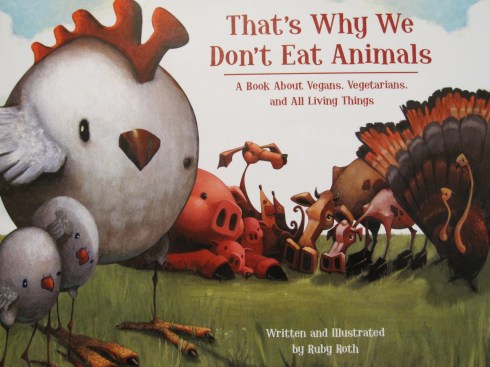
Beware! There’s a new children’s book coming out this week. It’s called “Vegan is Love: Having Heart & Taking Action,” by Ruby Roth. A book about living compassionately surely needs a warning label, don’t you think? Fortunately, the U.S. media’s version of that label aired on Friday, April 20th on NBC’s The Today Show.
The show’s pre-recorded segment with Ruby Roth about her new book was a positive portrayal of vegan parenting. Ruby’s young stepdaughter indicated that her favorite food is KALE. Impressive! Fortunately, the nutritional integrity of a healthy vegan diet for children was not called into question…because it shouldn’t be.
Instead…great “concerns” were voiced by the 2 in-studio guests regarding the supposed use of “scare tactics” in the book (surrounding food as well as other issues of animal exploitation, such as animal testing.) To hear the guests speak, you’d think that Ruby’s book will scar children for life:
“There is so much fear in this book.” “Why do we have to scare them?” The book is “teaching kids to fear food.” Fear, guilt, “graphic pictures:” Very scary stuff.
But who is really afraid of this stuff? Is it really the children? Will they seriously be harmed by a book that honestly exposes them to the real world? Are children so fragile that they cannot handle the truth about animal exploitation, when it is presented with gentle candor and realistic illustrations? Will children truly react negatively, or will they logically respond with compassion and concern? Won’t children want to help animals and take action? I don’t think we give children nearly enough credit.
I think the adults are the fearful ones. Fearful and feeling guilty. It’s actually the adults who can’t bear to look at graphic pictures of animal slaughter. Adults won’t listen to the truth about unnecessary animal exploitation. Adults are resistant to change. Adults don’t want their routines disrupted, their palate pleasure disturbed, or their minds opened.
Are adults– parents– most of all afraid of having their own apathy exposed? If, for example, their children reads the book elsewhere and comes home to share the cruel truths with them…what then? How will they justify their own complicity in the violence? How will they try to convince their children that they do care when maybe they really don’t? Or, if they genuinely care, then how will they explain the hypocrisy in their actions? Children are quite capable of recognizing inconsistencies.
Let’s stop pretending to worry about the children. They’re just fine. Children are inherently open-minded, curious, and adaptable. Children very easily grasp the basic concept of Veganism, which is about non-harming. Young children, in particular, naturally consider animals their friends. Why would they want to hurt their friends?
“Vegan is Love” gently asks young readers to take personal responsibility in the form of taking actions that help make the world a better place for animals. Children are not afraid to do that. They are not fearful. Adults could learn a lot from children.
Here is a perfect example of what I’m talking about, written by my vegan friend from Indonesia:
“I did a talk on Veganism to a bunch of 7 year olds. They totally get it. We also went to a local market in Indonesia and one of the kids happened to see a chicken killed. During the subsequent talk about what happened, children mentioned how horrible that was. I said, I know, but how to you think the meat comes to you? One little girl said, ‘I think it’s mean. That chicken wants to have a family and look after its babies too!’ I said ‘I agree with you,’ and she said, completely off her own back, ‘I don’t think I want to eat animals either!’ Kids get it.”
Check out Ruby Roth’s website here: http://wedonteatanimals.com/
(Picture is my copy of Ruby Roth’s first book, “That’s Why We Don’t Eat Animals”)
The problem is animal exploitation. The solution is Veganism.
Step 1: You. Change must start with YOU. First you go vegan. You stop consuming animals, wearing animals, and buying products made of animals or tested on animals. You stop going to venues using animals to entertain. You stop accepting that animals are just commodities to use. You start thinking about animals as individuals with their own interests. Simple.
Step 2: NOW WHAT?? Now that you’ve changed, what do you do next? Do you leave it at that? Or, do you speak up and try to help effect change in others? Remember – the point of going vegan isn’t to join a “club” that follows a strict set of “rules.” The point is to help solve a very serious social justice problem.
Solving problems of gargantuan proportion depends on the collective effort of many. No “group” is more oppressed than non-human animals. For the human culture to stop conceptualizing animals as primarily “things to consume” is going to take a monumental push for change.
Definitions: “push”
- To urge forward or urge insistently; pressure: “Push a child to study harder.”
- To extend or enlarge: “Push society past the frontier.”
- To promote or sell: “The author pushed her latest book.”
So who is pushing for change? Vegans. Non-vegans won’t do it. Vegetarians won’t do it. Vegans are the only ones advocating 100% for the rights of animals not to be used.
Passionate vegans work for the greater good. By promoting Veganism, we “urge” others to act with fairness toward sentient beings. We put “pressure” on the status quo. We ask others to “enlarge” their circle of compassion to include all animals. We “promote” non-violence. These are good things. Yet, passionate, active, vocal vegans are frequently called “pushy.”
Definition: “pushy”
- offensively assertive or forceful
- marked by aggressive ambition and energy and initiative
Hmm…pushy sounds bad. So how did we get from “push” to “pushy?” How did we get from the words, “urge forward / extend / promote” to “offensive” and “aggressive?”
I think it has more to do with how non-vegans react to being challenged than anything else. I don’t think it really matters what the frequency– the content– the delivery method– of the vegan message is. The vegan message itself is considered inherently “aggressive” in a culture where animal exploitation is ubiquitous. Where animal slaughter is condoned, those who speak in protest are considered the “offensive” ones. All a vegan has to do is open his or her mouth to be labelled “pushy.” No one minds a quiet vegan!
Push…pushy. It doesn’t really matter. The bottom line is we have a long way to go to shift the paradigm. The animals need our help so we can’t keep quiet. So, spreaders of the vegan message: Keep pushing for change…you pushy, pushy vegans!
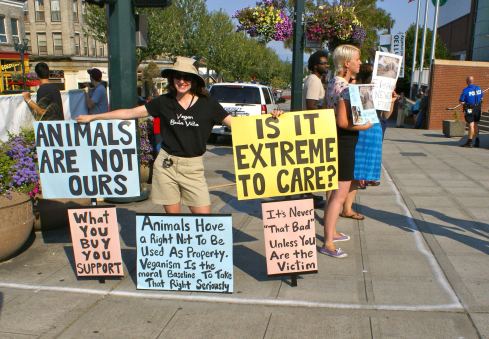
(Picture taken September 12, 2011 at the Ringling Circus protest in Everett, WA)



 Freeheel Vegan