
You are currently browsing the tag archive for the ‘vegetables’ tag.

This is a quick vegan lasagna I whipped up tonight. My goals were:
- to use up some lasagna noodles I’ve had in my pantry for a long time.
- to use fewer noodles, to substitute vegetables (zucchini and cauliflower) for some noodles.
- to use a packet of Road’s End Organics Cheddar Style Gluten Free Chreese Sauce Mix that I had in the pantry.


INGREDIENTS:
6 Lasagna noodles: Cook them partially and set aside
1 Zucchini, sliced lengthwise in 1/4″ strips
Cauliflower, sliced in 1/4″ strips
Artichoke hearts
Make 1 packet Road’s End Organics Cheddar Style GF Chreese Sauce Mix
OR use some Daiya Cheddar Style or Mozzarella Style Shreds
OR make some vegan cheese sauce from a homemade dry mix (i.e. recipes in The Ultimate Uncheese Cookbook, by Jo Stepaniak)
1- 26 oz jar pasta sauce
1 C Italian Mushroom Saute
Italian seasoning blend
Garlic powder
Crushed red pepper flakes
ASSEMBLY:
First Layer
Use a square glass pan. Spoon some pasta sauce on the bottom. Add 2 noodles. Spread vegan cheese sauce (or shreds) over the noodles.

Second Layer
Set some zucchini slices, cauliflower slices and artichoke hearts on top of the cheese. Spoon some Italian Mushroom Saute and pasta sauce over the vegetables.

Repeat the layering process 3 times. Spread the remaining pasta sauce on top, then sprinkle with Italian seasoning blend, garlic powder and crushed red pepper flakes.
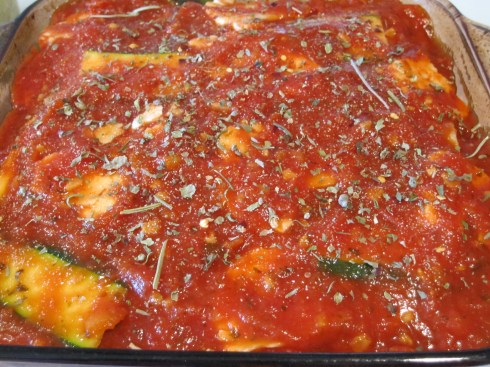
Line the bottom of the oven with a piece of foil to catch any bubbly overflow.
Bake at 375 degrees, covered for 35 minutes. Continue baking uncovered for 25 minutes, to evaporate excess moisture. Turn off the oven, crack open the door and let it rest in the oven for another 10-15 minutes.
Makes 4 servings.

Thank YOU– for making your lasagna without meat and dairy.
I first learned about “blended salad” from Dr. Joel Fuhrman. If you don’t know who Dr. Fuhrman is, be sure to click the link! In my opinion, his book “Eat to Live” is one of the best books on nutrition. I love his “nutritarian” approach to health. It’s all about nutrient density.
A blended salad is basically another type of green smoothie. My morning green smoothie contains a lot of fruit. My evening blended salad contains mostly vegetables.
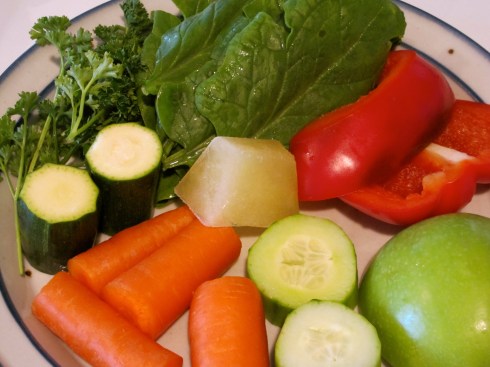
Here’s what I put in my blended salad last night (serves 2):
Parsley, spinach, zucchini, carrot, cucumber, apple, red pepper and lemon juice (frozen).
PREPARATION
These are tips for preparing lots of vegetables ahead of time. This cuts down on the amount of work involved. If it’s too much work, then you probably won’t make blended salads regularly. Not good!
1. Buy several bunches of parsley. Discard the thickest stems. (I don’t need that much fiber!) Rinse, spin dry, and freeze on parchment paper. Store in a freezer container.
2. Have dark leafy greens in your fridge at ALL times. Rotate through kale, spinach, chard, collards, etc. Rinse the leaves and remove the tough stem. Most of the time I throw the stem away, but sometimes I mince it up for soup.
3. Buy a large variety of vegetables and apples. Wash, chop (2″ pieces) and freeze most of it. Always save some of everything for the fridge. Don’t forget about tomatoes, celery, and avocado. Keep the tomatoes and avocado fresh.
4. Use a citrus reamer to juice a whole bunch of lemons at once. Freeze the juice in ice cube trays.
5. If you have a juicer, you can also juice some of the vegetables and freeze the juice in ice cube trays. Using some vegetable juice instead of all whole veggies will cut down on some of the fiber (if getting too much fiber is an issue.) Save your carrot pulp for other uses (like these muffins).
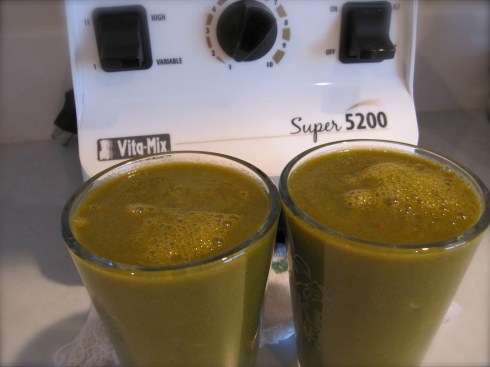
5. Blend everything in a high-powered blender like a Vitamix. Add at least a cup of water per serving.
It’s interesting to read nutrition charts showing the percentage of protein, carbohydrate, and fat found in fruits and vegetables. People are surprised to learn that fruits contain protein and vegetables contain fat.
Please repeat after me:
ALL PLANTS CONTAIN PROTEIN.
PARSLEY: 27% protein, 57% carb, 16% fat
SPINACH: 39% protein, 49% carb, 12% fat
ZUCCHINI: 25% protein, 67% carb, 8% fat
CARROT: 8% protein, 87% carb, 5% fat
CUCUMBER: 19% protein, 69% carb, 12% fat
APPLE: 2% protein, 95% carb, 3% fat
RED PEPPER: 13% protein, 78% carb, 9% fat
LEMON: 7% protein, 90% carb, 3% fat
(Protein, carb, and fat percentages are from the book, “Becoming Raw: The Essential Guide to Raw Vegan Diets,” by Brenda Davis and Vesanto Melina. This is another excellent book on nutrition. You don’t need to be “raw” to read it.)
Happy blending!




 Freeheel Vegan