
You are currently browsing the tag archive for the ‘protein’ tag.
I first learned about “blended salad” from Dr. Joel Fuhrman. If you don’t know who Dr. Fuhrman is, be sure to click the link! In my opinion, his book “Eat to Live” is one of the best books on nutrition. I love his “nutritarian” approach to health. It’s all about nutrient density.
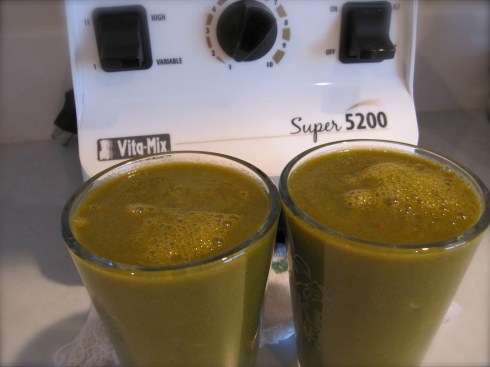
A blended salad is basically another type of green smoothie. My morning green smoothie contains a lot of fruit. My evening blended salad contains mostly vegetables.
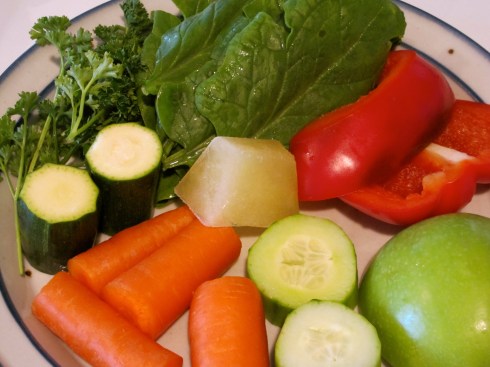
Here’s what I put in my blended salad last night (serves 2):
Parsley, spinach, zucchini, carrot, cucumber, apple, red pepper and lemon juice (frozen).
PREPARATION
These are tips for preparing lots of vegetables ahead of time. This cuts down on the amount of work involved. If it’s too much work, then you probably won’t make blended salads regularly. Not good!
1. Buy several bunches of parsley. Discard the thickest stems. (I don’t need that much fiber!) Rinse, spin dry, and freeze on parchment paper. Store in a freezer container.
2. Have dark leafy greens in your fridge at ALL times. Rotate through kale, spinach, chard, collards, etc. Rinse the leaves and remove the tough stem. Most of the time I throw the stem away, but sometimes I mince it up for soup.
3. Buy a large variety of vegetables and apples. Wash, chop (2″ pieces) and freeze most of it. Always save some of everything for the fridge. Don’t forget about tomatoes, celery, and avocado. Keep the tomatoes and avocado fresh.
4. Use a citrus reamer to juice a whole bunch of lemons at once. Freeze the juice in ice cube trays.
5. If you have a juicer, you can also juice some of the vegetables and freeze the juice in ice cube trays. Using some vegetable juice instead of all whole veggies will cut down on some of the fiber (if getting too much fiber is an issue.) Save your carrot pulp for other uses (like these muffins).
5. Blend everything in a high-powered blender like a Vitamix. Add at least a cup of water per serving.
It’s interesting to read nutrition charts showing the percentage of protein, carbohydrate, and fat found in fruits and vegetables. People are surprised to learn that fruits contain protein and vegetables contain fat.
Please repeat after me:
ALL PLANTS CONTAIN PROTEIN.
PARSLEY: 27% protein, 57% carb, 16% fat
SPINACH: 39% protein, 49% carb, 12% fat
ZUCCHINI: 25% protein, 67% carb, 8% fat
CARROT: 8% protein, 87% carb, 5% fat
CUCUMBER: 19% protein, 69% carb, 12% fat
APPLE: 2% protein, 95% carb, 3% fat
RED PEPPER: 13% protein, 78% carb, 9% fat
LEMON: 7% protein, 90% carb, 3% fat
(Protein, carb, and fat percentages are from the book, “Becoming Raw: The Essential Guide to Raw Vegan Diets,” by Brenda Davis and Vesanto Melina. This is another excellent book on nutrition. You don’t need to be “raw” to read it.)
Happy blending!

A few years ago, I bought some Orca beans from the CSA in Wenatchee, WA. Then they just sat in my pantry…

Finally I decided to use them. When they cooked up, the water turned black and the beans turned brown! I found out that Orca beans are an heirloom variety from Mexico, rare in the U.S. (No wonder they remind me of pinto beans).
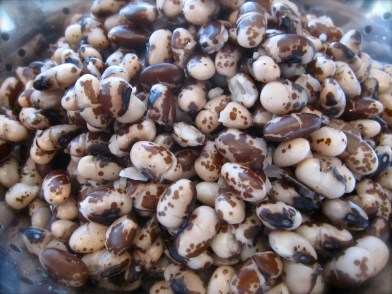
Purcell Mountain Farms’ website has a fascinating, long list of beans for purchase. There are some really interesting names on that list! Eye of the Goat Beans, Marrow Beans, Tongues of Fire Beans…these sound exactly like what a vegan witch would add to her cauldron of animal-free stew. Ah, the abundance! (Where do you get your protein?)
I didn’t make soup or stew. I decided to make up a triple batch of hummus using my Orca beans instead of garbanzo beans. Two cups dry beans yielded about 3 pints cooked.

To make 1 batch of hummus, puree:
1 pint cooked beans
Juice of 1 lemon
2 T tahini (sesame butter)
1 T olive oil
2 minced cloves garlic
1/2 t cumin
1/2 t coriander
1/4 t turmeric
1-2 T water (if needed to thin)
Portion and freeze in 1/2 to 1 cup canning jars.
Don’t let your freezer run out of hummus!



 Freeheel Vegan