You are currently browsing the category archive for the ‘Think About It’ category.

“Experience the Cabela’s Adventure Today” -Cabela’s website
A new Cabela’s store opened April 19, 2012 in Tulalip, Washington. “Hunting. Fishing. Outdoor Gear. World’s Foremost Outfitter.” Oh, joy. Exactly what the world needs more of: glorification of animal killing.
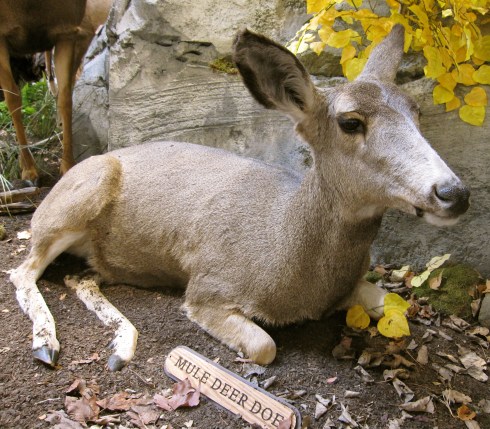
“Walk through the main door and look up to see two mounted Orcas chasing a school of Chinook.” -HeraldNet

Since opening day, the parking lot’s been constantly packed. I know this because I drive past the place every time I drive to and from work. (Between the Tulalip Tribe Resort/Casino, the new Cabela’s and the adjacent Seattle Premium Outlets (outlet mall), there is no evidence that I can see of our “down economy.” But, I digress.)
“Displays will feature 200 animal mounts, including bears, elk, grouse and otters.” -HeraldNet

There is a banner displayed on the outside of the store: “Personal Defense & Home Protection.”

Let me see if I’ve got this straight: You’re the quintessential Cabela’s customer. You enter the store to buy items that are specifically designed to– track, sight, call, bait, lure, decoy, catch, shoot, target, kill, gut, skin, butcher, season, cure, brine, grill, dehydrate, smoke, grind, slice, and vacuum seal– living, breathing, sentient animals who are simply minding their own business, trying to survive and thrive. Right so far?

You– Mr. Average Joe Hunter & Mr Average Bob Fisherman– go out in nature with all of your Cabela’s “goods” with the hope that something– someone— will die at your hands. If the purchased items fulfill their intended purposes, then lives will be taken.
You want to take the life of an animal. It’s not your life, it’s his life (or hers). But you want it for yourself. His body belongs to him, but you don’t care. You feel entitled to it. You don’t consider his needs, only your own wants. You don’t empathize with the animal, despite the fact that he will fight to survive in whatever situation becomes threatening to him.
How ironic that…
When you navigate the world, you want to remain comfortable. You seek contentment. You know that your life is your own. Your body belongs to you. You withdraw from pain. You don’t want to be hurt, and you don’t want to be killed. You will defend yourself against threats to your safety and the safety of your family. Maintain “PERSONAL DEFENSE.”
When you come home, you expect that your shelter will be undisturbed. You don’t want others to take that which does not belong to them. You assume that your belongings are secure because “what’s yours is yours.” Maintain “HOME PROTECTION.”
Sorry, I don’t get it.
You want to take the life of another, but you don’t want to have the same circumstance visited upon yourself? It makes no sense to me whatsoever. Can’t you see the contradiction? Can’t you choose to live in a better way? If you think you have the courage to do so, then I can help show you how. Let me help you.

“This is freaking impressive,” said Tyler Schmidt, a 16-year-old from Arlington making his first visit to a Cabela’s store. “When I die, this is where I want to go.” -Marysville Globe
I like this comedy bit from Ellen Degeneres about hunting:
http://www.youtube.com/watch?v=8DB4KtOmFok
http://www.heraldnet.com/article/20120328/BIZ/703289893
http://www.heraldnet.com/article/20120412/SPORTS/704129877
http://www.marysvilleglobe.com/business/148172445.html
http://www.cabelas.com/browse.cmd?categoryId=112426380#feature
Beware! There’s a new children’s book coming out this week. It’s called “Vegan is Love: Having Heart & Taking Action,” by Ruby Roth. A book about living compassionately surely needs a warning label, don’t you think? Fortunately, the U.S. media’s version of that label aired on Friday, April 20th on NBC’s The Today Show.
The show’s pre-recorded segment with Ruby Roth about her new book was a positive portrayal of vegan parenting. Ruby’s young stepdaughter indicated that her favorite food is KALE. Impressive! Fortunately, the nutritional integrity of a healthy vegan diet for children was not called into question…because it shouldn’t be.
Instead…great “concerns” were voiced by the 2 in-studio guests regarding the supposed use of “scare tactics” in the book (surrounding food as well as other issues of animal exploitation, such as animal testing.) To hear the guests speak, you’d think that Ruby’s book will scar children for life:
“There is so much fear in this book.” “Why do we have to scare them?” The book is “teaching kids to fear food.” Fear, guilt, “graphic pictures:” Very scary stuff.
But who is really afraid of this stuff? Is it really the children? Will they seriously be harmed by a book that honestly exposes them to the real world? Are children so fragile that they cannot handle the truth about animal exploitation, when it is presented with gentle candor and realistic illustrations? Will children truly react negatively, or will they logically respond with compassion and concern? Won’t children want to help animals and take action? I don’t think we give children nearly enough credit.
I think the adults are the fearful ones. Fearful and feeling guilty. It’s actually the adults who can’t bear to look at graphic pictures of animal slaughter. Adults won’t listen to the truth about unnecessary animal exploitation. Adults are resistant to change. Adults don’t want their routines disrupted, their palate pleasure disturbed, or their minds opened.
Are adults– parents– most of all afraid of having their own apathy exposed? If, for example, their children reads the book elsewhere and comes home to share the cruel truths with them…what then? How will they justify their own complicity in the violence? How will they try to convince their children that they do care when maybe they really don’t? Or, if they genuinely care, then how will they explain the hypocrisy in their actions? Children are quite capable of recognizing inconsistencies.
Let’s stop pretending to worry about the children. They’re just fine. Children are inherently open-minded, curious, and adaptable. Children very easily grasp the basic concept of Veganism, which is about non-harming. Young children, in particular, naturally consider animals their friends. Why would they want to hurt their friends?
“Vegan is Love” gently asks young readers to take personal responsibility in the form of taking actions that help make the world a better place for animals. Children are not afraid to do that. They are not fearful. Adults could learn a lot from children.
Here is a perfect example of what I’m talking about, written by my vegan friend from Indonesia:
“I did a talk on Veganism to a bunch of 7 year olds. They totally get it. We also went to a local market in Indonesia and one of the kids happened to see a chicken killed. During the subsequent talk about what happened, children mentioned how horrible that was. I said, I know, but how to you think the meat comes to you? One little girl said, ‘I think it’s mean. That chicken wants to have a family and look after its babies too!’ I said ‘I agree with you,’ and she said, completely off her own back, ‘I don’t think I want to eat animals either!’ Kids get it.”
Check out Ruby Roth’s website here: http://wedonteatanimals.com/
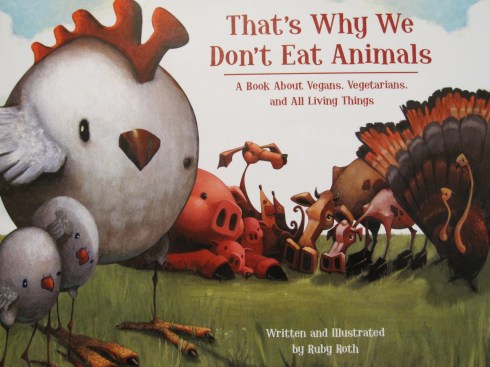
(Picture is my copy of Ruby Roth’s first book, “That’s Why We Don’t Eat Animals”)

 Freeheel Vegan